

Solid Cleansing Oils Market to Reach USD 3.3 Billion by 2036, Driven by Sustainability and Daily Skincare Trends
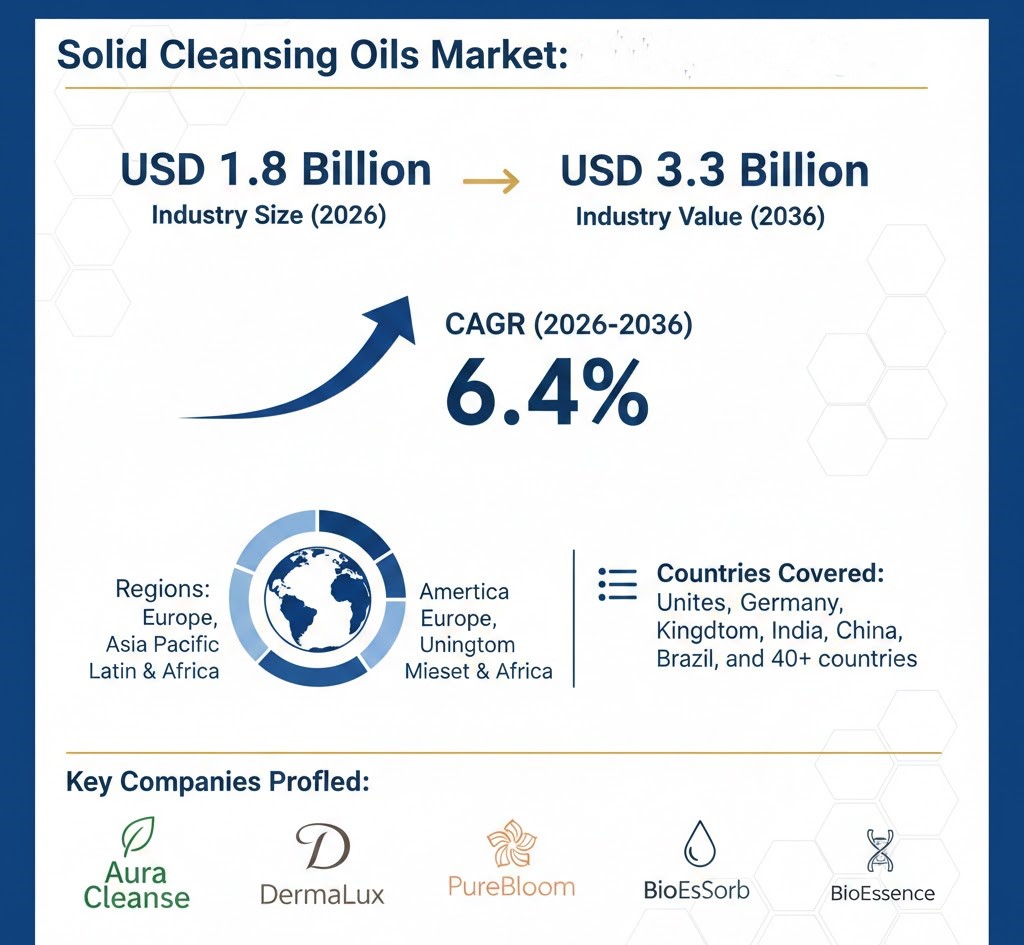
Solid Cleansing Oils Market
Global solid cleansing oils market valued at USD 1.8 billion in 2026, projected to grow at 6.4% CAGR, driven by rising skincare sustainability demand.
NEWARK, DE, UNITED STATES, February 4, 2026 /EINPresswire.com/ -- The global solid cleansing oils market is experiencing transformative growth, with market value projected to rise from USD 1.8 billion in 2026 to USD 3.3 Billion by 2036, expanding at a compound annual growth rate (CAGR) of 6.4%, according to a comprehensive forecast by Future Market Insights (FMI). This expansion is underpinned by shifting consumer preferences towards multi-functional, waterless skincare formats that combine makeup removal, cleansing, and skin conditioning in a single step, while addressing packaging and preservation challenges associated with traditional liquid oils.
Solid cleansing oils offer a practical solution to common issues with liquid oils, such as leakage during travel, the need for preservatives, and excessive packaging. Their solid form enhances stability and convenience while maintaining effective makeup removal and skin conditioning. This innovation aligns closely with consumer demands for multifunctional, eco-friendly skincare products that simplify daily routines.
Request For Sample Report | Customize Report |purchase Full Report – https://www.futuremarketinsights.com/reports/sample/rep-gb-31799
Market Context and Dynamics
• Solid cleansing oils are anhydrous, solid-format oil-based facial cleansers designed to dissolve makeup, sunscreen, and impurities efficiently. The market’s growth reflects a broader industry trend favoring compact, sustainable, and microbiome-friendly products that align with modern mobile lifestyles and heightened environmental awareness.
• “Environmental consciousness is maturing into deep sustainability expectations,” says Vidhi Arya, Beauty Industry Analyst and Author. “This includes biodegradable packaging, responsibly sourced bioactive ingredients, waterless formulas, and transparent supply chains. In 2026, these will no longer be optional but expected.”
• Between 2024 and 2026, product development has focused heavily on waterless formulations incorporating plant-derived and fermented lipids such as squalane and jojoba, which support skin barrier health without compromising sensory experience. This evolution has encouraged both established brands to expand solid cleansing oils within their core skincare portfolios and emerging companies to innovate with refillable packaging and simplified ingredient lists.
Market Segmentation and Key Trends
• Product Types: Traditional solid cleansing oils dominate with a 54.6% market share, favored for their ability to integrate seamlessly into daily cleansing routines. Disposable and unit-dose formats cater primarily to travel or occasional use, while other niche variants address specialized consumer needs.
• Application Focus: Face cleansing oils account for 63.2% of demand, functioning as the primary step in makeup and sunscreen removal. Lip and eye cleansing oils hold a smaller share due to targeted and less frequent use.
• Regional Insights: China leads the market with an 8.64% CAGR, driven by widespread adoption of double-cleansing routines and urban consumers’ embrace of solid skincare formats. India follows with 8.0% growth, supported by rising urbanization and skincare awareness. Germany’s 7.36% CAGR reflects strong sustainability-driven purchasing, while Brazil (6.72%), the United States (6.08%), the UK (5.44%), and Japan (4.8%) show steady but varied adoption rates.
Market Drivers and Consumer Behavior
The transition of solid cleansing oils from niche travel products to everyday essentials is fueled by consumer demand for cleansing solutions that deliver efficacy, skin tolerance, and ease of use. Solid cleansing oils mitigate issues common with liquids—such as leakage, dependence on preservatives, and high packaging volumes—while aligning with evolving environmental standards.
Notably, brands like Lush Cosmetics and Herbivore Botanicals have integrated solid cleansing oils into their permanent offerings, moving beyond their prior positioning as specialty or sustainability options. This integration supports routine use and repeat purchasing, signaling solid cleansing oils’ maturation from novelty formats to skincare staples.
E-commerce channels play a pivotal role, leveraging the products’ lightweight and shelf-stable nature to facilitate subscription replenishment models and direct-to-consumer sales. This digital-first approach has accelerated consumer trial and acceptance, particularly in Asian and urban markets.
Competitive Landscape
The market exhibits moderate concentration with key players holding significant shares:
• Shu Uemura: Leading with an estimated 17.8% market share, the brand maintains a stronghold due to its expertise in professional makeup removal and recent expansion into solid cleansing oils.
• Asian Brands: Biore, MISSHA, and ZA intensify competition through high-volume, daily-use formulations deeply embedded in oil cleansing culture.
• Dermatology-Focused Brands: Avène and Neutrogena differentiate by emphasizing skin tolerance and gentle cleansing, aligning solid oil formats with dermatological standards.
Recent product launches reflect these dynamics:
• September 2025: Shu Uemura introduced a solid oil cleanser complementing its liquid range.
• October 2025: Biore expanded its facial cleansing line with a compact solid oil variant designed for routine use.
• November 2025: Neutrogena piloted solid oil cleansers in select assortments, highlighting gentle cleansing and daily compatibility.
Challenges and Outlook
While consumer loyalty to liquid oils and sensitivity to formulation performance pose adoption barriers, the growing integration of solid cleansing oils within mainstream skincare assortments is expected to overcome these challenges. Formulation refinement focusing on oil composition, melting point, and emulsification ensures consistent cleansing efficacy and sensory appeal, fostering repeat usage and trust.
China’s rapid growth underscores the importance of urbanization, routine acceptance, and e-commerce penetration, whereas markets like Germany and Brazil exemplify the impact of sustainability consciousness and climate-driven skincare habits.
Market Definition and Scope
The solid cleansing oils market encompasses balm-to-oil cleansers, solid oil bars, and tabletized formats used for daily facial cleansing, makeup, and sunscreen removal. It excludes liquid oils, micellar waters, foaming cleansers, and professional-use-only products. Market sizing reflects consumer sales across retail, specialty, pharmacy, brand-owned, and digital channels globally, segmented by product type, application, and region.
Browse Related Insights
Prebiotic Deodorants Market: https://www.futuremarketinsights.com/reports/prebiotic-deodorant-market
Dry and Wet Wipes Market: https://www.futuremarketinsights.com/reports/dry-and-wet-wipes-market
Men’s Grooming Products Market: https://www.futuremarketinsights.com/reports/mens-grooming-products-market
Liquid Hand Soap Market: https://www.futuremarketinsights.com/reports/liquid-hand-soap-market
About Future Market Insights (FMI)
Future Market Insights, Inc. (FMI) is an ESOMAR-certified, ISO 9001:2015 market research and consulting organization, trusted by Fortune 500 clients and global enterprises. With operations in the U.S., UK, India, and Dubai, FMI provides data-backed insights and strategic intelligence across 30+ industries and 1200 markets worldwide.
Sudip Saha
Future Market Insights Inc.
+1 347-918-3531
email us here
Legal Disclaimer:
EIN Presswire provides this news content "as is" without warranty of any kind. We do not accept any responsibility or liability for the accuracy, content, images, videos, licenses, completeness, legality, or reliability of the information contained in this article. If you have any complaints or copyright issues related to this article, kindly contact the author above.
